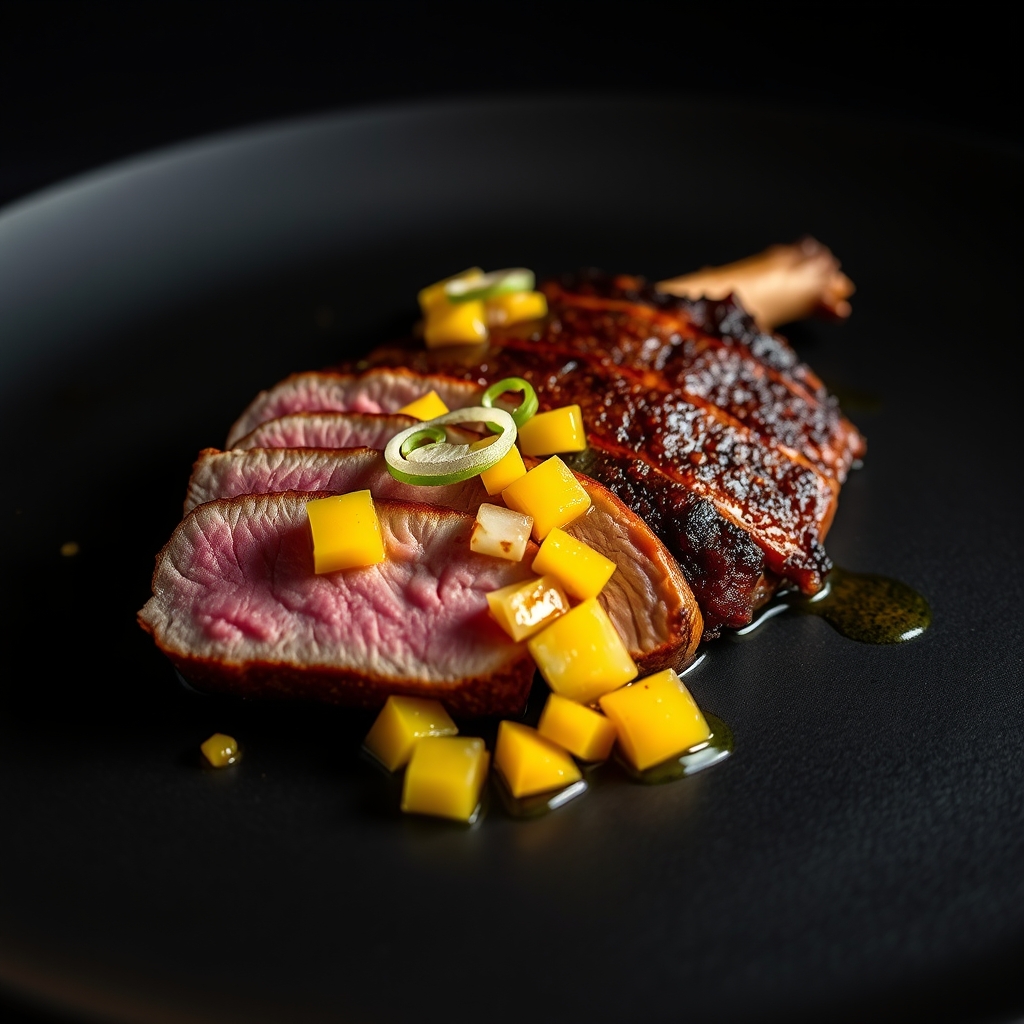
Duck Breast with Mango and Spring Onion
Scandinavian precision meets tropical sweetness
The marriage of duck and fruit is one of the great traditions of French cuisine—duck à l'orange being the most famous example. But the French, despite their culinary prowess, didn't have access to the mango, that impossibly fragrant stone fruit from South Asia that ripens into something approaching perfection. When you combine the rich, gamey fat of duck breast with the sweet-tart complexity of ripe mango, sharpened with ginger and lime and softened with honey, you get something that neither culture could have invented alone.
This recipe takes the Scandinavian approach to duck—scored skin, rendered slowly to achieve maximum crispness—and pairs it with a sauce that draws from Asian flavors without attempting to be authentically anything. The spring onions, cut on the bias and added at the last moment, provide freshness and a mild allium note that ties everything together. The chili is optional but recommended; its heat cuts through the richness of the duck fat in a way that makes you want another bite.
The key to duck breast is patience during the rendering process. Start skin-side down in a cold pan and let the fat slowly melt away, basting the meat with its own deliciousness. Rush this step and you'll have flabby skin and a kitchen full of smoke.
Method
-
1
Score and season the duck
Using a sharp knife, score the duck skin in a crosshatch pattern at 1cm intervals, cutting through the fat but not into the meat. Season generously with salt and pepper on both sides.
-
2
Render the fat
Place duck breasts skin-side down in a cold, heavy skillet. Turn heat to medium-low and cook for 15-18 minutes, pouring off rendered fat occasionally, until skin is deep golden and crispy.
💡 Don't rush this step—low and slow is essential.
-
3
Sear the meat side
Flip breasts and add the oil. Increase heat to medium-high and cook for 3-4 minutes for medium-rare, or until internal temperature reaches 54°C. Transfer to a board and rest, loosely tented, for 10 minutes.
-
4
Prepare the mango
While duck renders, peel and dice the mangoes into 1cm cubes. Set aside one-third of the prettiest cubes for garnish.
-
5
Build the sauce
Pour off all but 1 tbsp of duck fat from the skillet. Add sugar and let it caramelize lightly over medium heat. Add vinegar and wine, scraping up any fond. Reduce by half.
-
6
Finish the sauce
Add stock, ginger, lime zest, lime juice, and honey. Simmer for 5 minutes. Add two-thirds of the mango and cook for 2 minutes until softened. Season with salt and chili if using.
-
7
Slice and serve
Slice the rested duck against the grain into 1cm medallions. Arrange on plates and spoon sauce over. Scatter with reserved mango cubes and spring onions cut on the bias.
Notes & Tips
Mango selection
- • The mangoes must be ripe—fragrant at the stem end and yielding slightly to pressure. Unripe mango will be fibrous and sour. Ataulfo (honey) mangoes have the best flavor-to-fiber ratio.
Rendering tips
- • Start in a cold pan—this allows the fat to render gradually
- • Pour off fat every 5 minutes into a heat-proof container
- • Save the rendered duck fat—it's liquid gold for roasting potatoes
Resting is non-negotiable
- • Duck continues cooking as it rests. Cutting too soon releases all those precious juices onto your cutting board instead of into each bite.
Sauce consistency
- • If the sauce seems thin, remove the mango and reduce further. If too thick, add a splash of stock. It should coat the back of a spoon.
Wine pairing
- • A Gewürztraminer or off-dry Riesling complements the tropical fruit and ginger beautifully. For red, try a lighter Pinot Noir.
Make ahead
- • Score and season duck up to 24 hours ahead. The sauce base (without fresh mango) can be made a day ahead and reheated.